
A Guide to Hip Flexor Strains
If you’ve ever felt a sharp, stabbing pull in the front of your hip while sprinting, or a dull, nagging ache after a long day at your desk, you’ve likely met your hip flexors.
These muscles are the “hidden” powerhouse of your core, acting as the bridge between your upper and lower body. However, because they are involved in almost every move we make, they are incredibly prone to injury. Here is everything you need to know about identifying, understanding, and fixing a hip flexor strain.
What is Hip Flexor Muscle
The hip flexors are a group of muscles—most notably the iliopsoas and the rectus femoris—that allow you to lift your knee toward your chest and bend at the waist. When the muscle fibers in this group are stretched too far or forced to contract too suddenly, it results in a strain. This can range from a tiny “tweak” to a more serious tear that can sideline you for weeks.
Mechanism of Hip Flexor Injury
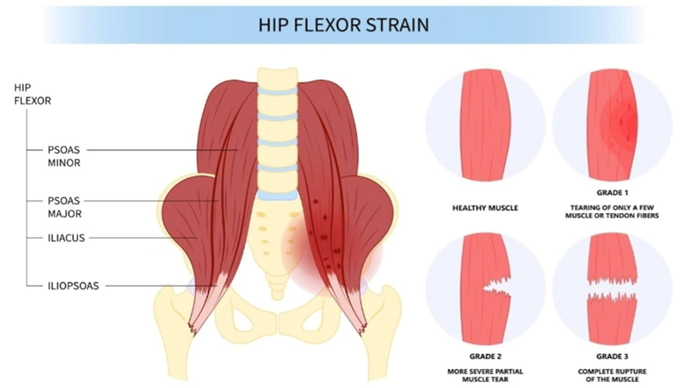
How does a strain actually happen? It generally occurs through one of two mechanical failures:
- Eccentric Overload: This is when the muscle is being lengthened while it is trying to contract. Imagine your leg being forced backward while you are trying to pull it forward.
- High-Velocity Contraction: This happens during explosive movements where the muscle is forced to shorten at extreme speeds, causing the fibers to snap under the tension.
Common Causes of Hip Flexor Strains
While anyone can strain a hip flexor, most injuries stem from these three scenarios:
- The “Weekend Warrior” Sprint: Sudden, explosive movements in sports like soccer, sprinting, or martial arts without a proper warm-up.
- The Sitting Trap: If you sit for 8+ hours a day, your hip flexors stay in a shortened, “tight” position. Over time, they become brittle. When you suddenly try to use them for a heavy workout, they aren’t flexible enough to handle the load.
- Overuse: Repetitive movements, such as long-distance
cycling or high-repetition “leg raises” in the gym, can cause micro-tears that eventually lead to a full strain.
Common Symptoms
How do you know it’s a strain and not just general tightness? Look for these signs:
- Localized Pain: Sharp pain or tenderness specifically in the “crease” where your leg meets your pelvis.
- Weakness: A noticeable struggle or “giving out” feeling when trying to lift your knee or walk up stairs.
- Visible Swelling or Bruising: In moderate to severe cases, the area may look inflamed.
- The “Clench” Sensation: A feeling that the muscle is constantly cramping or hitching when you try to move.
What Actually Helps?
Contrary to popular belief, “just stretching it” is often the worst thing you can do for an acute strain. Here is what actually works:
- Initial Protection (The 48-Hour Rule): Avoid any movement that causes sharp pain. Use ice for 15-minute intervals to manage the initial inflammation.
- Isometric Loading: Once the sharp pain subsides, start with “isometrics”—holding the muscle in a still position under slight tension. This tells the fibers to start healing without the risk of re-tearing.
- Glute Activation: Often, hip flexors overwork because your glutes (the muscles on the back) are weak. Strengthening your glutes provides a “counter-balance”
that takes the pressure off the front of your hip.
- Progressive Strengthening: Once healed, focus on eccentric strengthening (slowly lowering the leg) to build a muscle that is both long and strong.
Key Takeaways
- Don’t Stretch a Tear: If it’s a fresh injury, aggressive stretching is like pulling on a fraying rope. Rest first, strengthen later.
- Sit Less, Move More: Break up long periods of sitting to keep the muscles from “shortening” permanently.
- Warm Up Matters: Dynamic swings and lunges before a workout are your best insurance policy against a snap.
- Listen to the Pinch: A small “pinch” today is a warning. Ignoring it usually leads to a Grade 2 or 3 tear tomorrow.
Properly managing a hip flexor strain requires more than just rest; it requires the right loading and strengthening at the right time. Let our experts guide your rehabilitation with a custom-tailored recovery program. Contact our clinic to start your recovery journey.